Thursday, 8 March 2018

Cathedral Cave


Cathedral Cave can be found south of Papatowai in the Catlins (that's east of Invercargill). It is accessible only at low tide. It's very popular and there's a large car park to cater for all the tourists. It costs $5 per person as you need to pass through Maori land to get to the beach. 

After about a 20-minute walk through beautiful bush to get to the beach, there's another 10 minutes along the beach to get to the cave. The walk descends down to the beach, so coming back is all uphill.


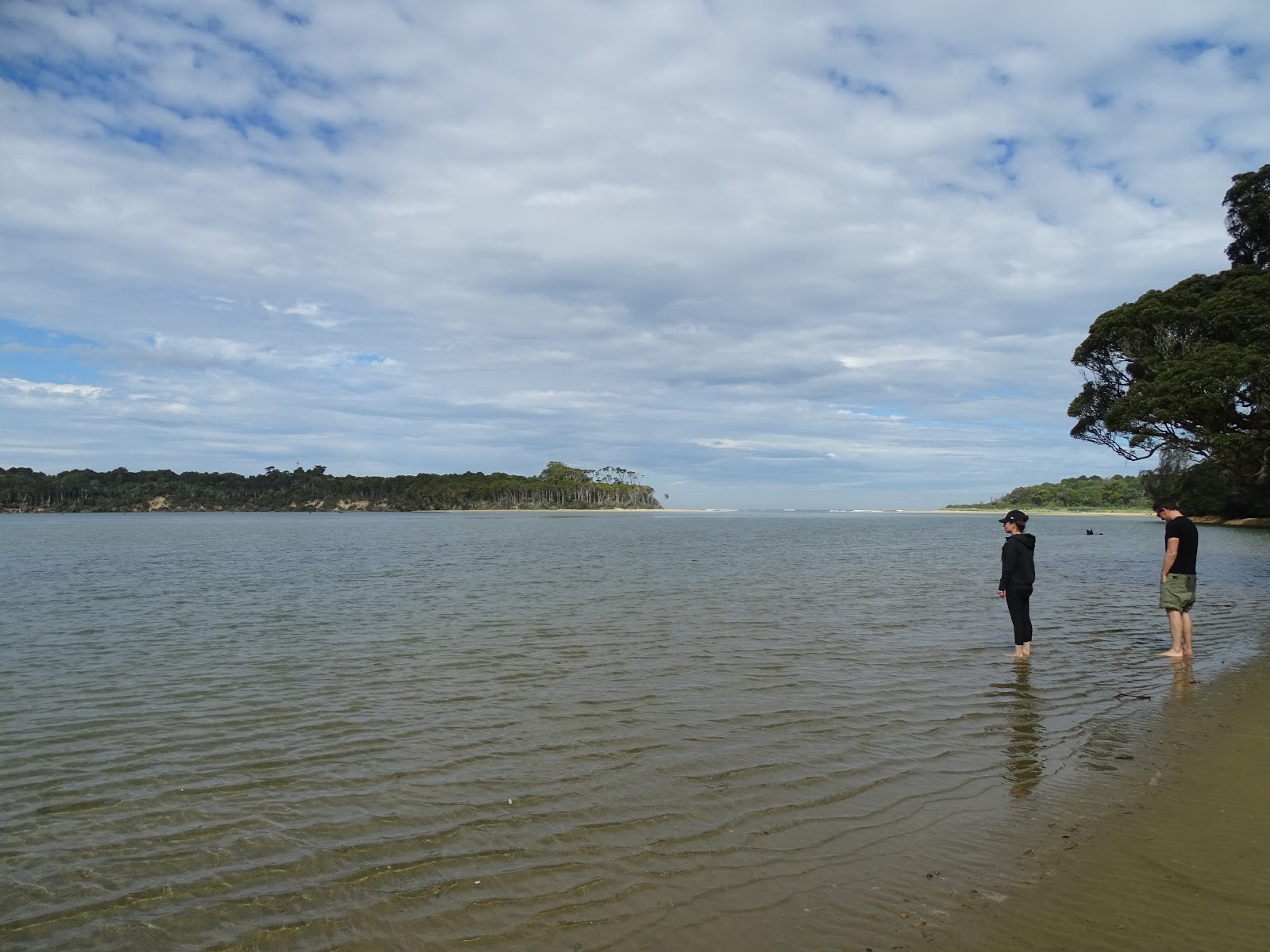
Arriving at the beach.


You're given an information sheet when you pay at the car park. Info from that sheet about the cave: Total passage length is 199 metres. Currently, this is one of the 30 longest known sea caves in the world. Sea caves are formed by the action of the waves eroding or collapsing the rock.

This is the first entrance. Just magnificent. The cave originally formed as two separate caves, which later joined at the back.
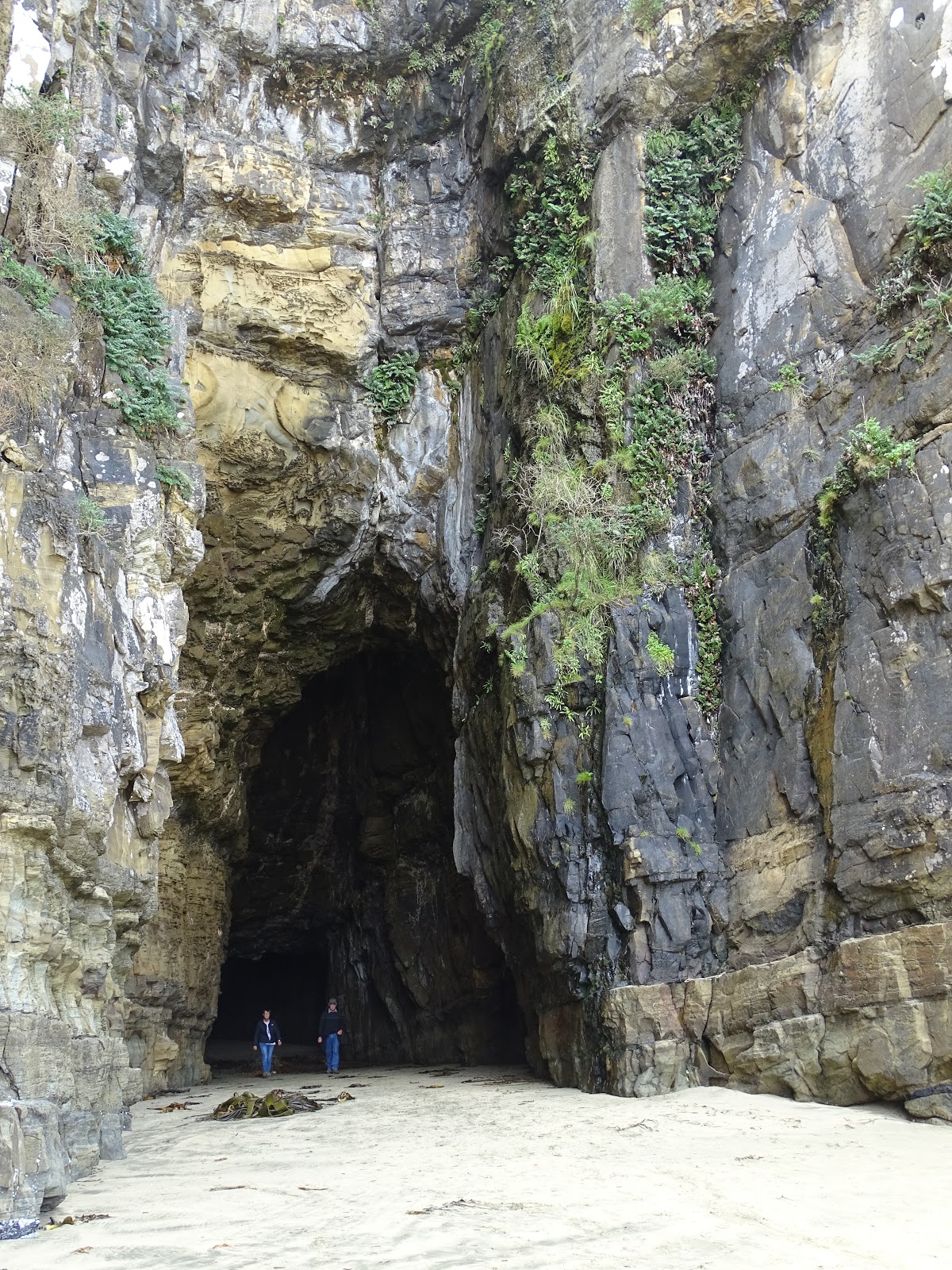
Looking up near at the entrance.

Although the roof looks lower here, its height varies inside.

A lot of people view this cave every day. It's flooded at high tide, so note the number of footprints in the sand. The low tide viewing time is an approximate window of about three hours, and there is a different exit (the second cave entrance).

We brought a torch, which helped us see into the darker places. This was the end of the cave.

Looking back towards the entrance of the cave where we had entered . . .

. . . and this was the second cave entrance, where we exited.

"Cathedral Cave is formed in resistant Jurassic sandstone", says the leaflet. "The sedimentary layers  are tilted slightly to the northeast (into the cliff). Stresses acting on the rocks when they were buried created near-vertical fractures, perpendicular to the sedimentary layers. It is these fractures that the waves exploit to form the cave."

Outside, looking back at the second entrance.

We could not get further around easily as the tide had cut us off. However, Dave decided to wade through the water to check it out. He told me there were more caves around the corner.

Here you can see the two entrances to the cave.

Then the walk back along the beach . . .

. . . and through the bush/forest. The walk was really part of the attraction. Just beautiful.


If you cannot see "Post a Comment" below, click here (and scroll down to the bottom of the post) to talk to me!  


Wednesday, 7 March 2018

Nugget Burn and Papatowai Campsite


This is a Park over Property (POP)Nugget Burnwhere we stayed near Kaka Point in the Catlins. The internet signal (Vodafone) was patchy and unreliable, so we had to move on after one night. It was a great place otherwiseclose to Nugget Point and other interesting spots like Cannibal Bay and Roaring BayThere was a wonderful beach right across the road from the entrance to the property. This is looking back at our rig just to the left of the middle of the photo.


Some other beach walkers told us of a sea lion they'd seen up in the dunes. We didn't go looking for it having sated our appetite for sea lions at Cannibal Bay the previous day. However, we saw these tracks in the sand where they'd come up out of the sea.

We moved on to Papatowai the next day.

DOC have a great campground at Papatowaithe entrance is between the bushes to the right of the photo. There's heaps of room and the way the plantings are set out give everyone a measure of privacy. The building in this photo is the Papatowai Country Store.

This is the view through my office window.

There was a path from the campground down to the beach. 

Just a short walk . . .

. . . and a wee tiny beach.

Off to the right we could see what looked like a lovely stretch of beach in the distance, so decided to take a drive and see if we could find it so Lucy could have a bit of a run.

Found it! 

Actually, Dave drove right down and parked on the beach while we went for a stroll. 

A couple of other lovely viewsthese photos taken from the side of the main road south of Papatowai.


If you cannot see "Post a Comment" below, click here (and scroll down to the bottom of the post) to talk to me!

Tuesday, 6 March 2018

Cannibal Bay and Roaring Bay


After leaving Nugget Point, we wanted to see the penguins reportedly at Roaring Bay just down the road. When we got to that car park, we found the best time to see them was after 4pm (or even later), as they come in from the sea for the evening. So we drove on further down the coast and took a narrow unsealed windy road out to Cannibal Bay.

As we arrived, a girl leaving the beach told us there were sea lions on the beach, and she'd almost walked into one as it had part buried itself in the sand. At first, I thought that was a little weird . . .

. . . and then I saw one! It WAS the same colour as the sand and I hadn't noticed it until it chose to sit up and stretch.

There were several sea lions on the beachmost of them sleeping in the sand.

This one had a tagged flipper. It was lying almost upside down . . .

 . . . happily snoozing, oblivous to us all giving it a wide berth.

Then there was this one that rose up as we walked by. Notice the sand it's flicked all over itself.


This is the car park, which is really just "find-a-space" on the side of the road. As we left, there were cars everywhere, blocking the road. Yes, this is the actual road.

Later that night, we headed back to Roaring Bay. We'd been told it was still foggy and we weren't guaranteed to see a penguin, but wanted to take our chances. It's a ten-minute walk from the car park down to the hide, which is a wooden building in the side of the cliff with narrow windows overlooking the bay. We arrived at about 7:10pm, and about twenty minutes later (after waiting quietly with a bunch of other tourists) our patience was rewarded! Dave saw the penguin first, swimming in and coming up out of the water. It came straight onto the rocks and then stood there preening itself for another twenty minutes.

In spite of the low light and the distanceI'm at maximum zoom here, so not amazingly sharp photosit was still very recognisable as an adult yellow-eyed penguin (hoiho). They are unique to New Zealand and are listed as an endangered species with an estimated wild population of less than 4,000. It is now the rarest penguin in the world.  Hence, I was thrilled to actually get to see (and photograph) one in the wild.

Standing at 65 cm tall, the yellow-eyed penguin is the fourth largest of the world's penguins.

This is a picture of the hide. It's not evident from this photo, but on the sea side, it is hidden behind a mound of the hill. Only the windows peep above the hill, allowing people to see out but keeping us as hidden as possible from the penguins. They are very shy and easily spooked and upset. Having been there almost an hour and photographed my penguin, I was ready to go home. You probably won't be able see the penguin on the rocks below the hide. It's just a white spot, but this photo may give you an idea of how far away we were. The penguin is just below the arrow.

If you cannot see "Post a Comment" below, click here (and scroll down to the bottom of the post) to talk to me!

Monday, 5 March 2018

Nugget Point


We visited Nugget Point on a foggy day and sadly, the visibility was poor. The closer we got to the end of the point, the foggier it became. Nevertheless, we got a taste of how magnificent the scenery is in this area. We are in the Catlins, southeast of Balclutha.
You can drive out toward the lighthouse, then need to park your car and walk the rest of the way.

Nearing the lighthouse. There IS a lighthouse at the end of this track!

There it is!


As you climb around the side of the lighthouse, there is a viewing platform. It was disappointing to know that the view from here would be stunning if we could just see it. But the fog was there to stay.

Looking down from part of the viewing platform poking out from the cliff on the south side is this wee bay.

On the walk back to the car park, looking back towards the tip were these rock structures. I understand that the view east out to sea from the lighthouse would have revealed more of these "nuggets", had the fog chosen to reveal its secrets. And these are what Nugget Point gets its name from.


On the way back, there was a little less fog. Looking back, you can see a viewing platform sticking out from the side of this cliff. This was by the lighthouse and where I stood a short time ago to take a photo of the bay below.

Looking down on the northern side of the path, there were these rock poolsand fur seals. Not so easy to seethey looked a little like slugs on the rocks.


The closer we got back to the car park, the less fog there was. The path at this point was really pretty. It was a shame the fog spoilt the view out nearer the point, but it was clearly a beautiful spot to visit.

If you cannot see "Post a Comment" below, click here (and scroll down to the bottom of the post) to talk to me!